
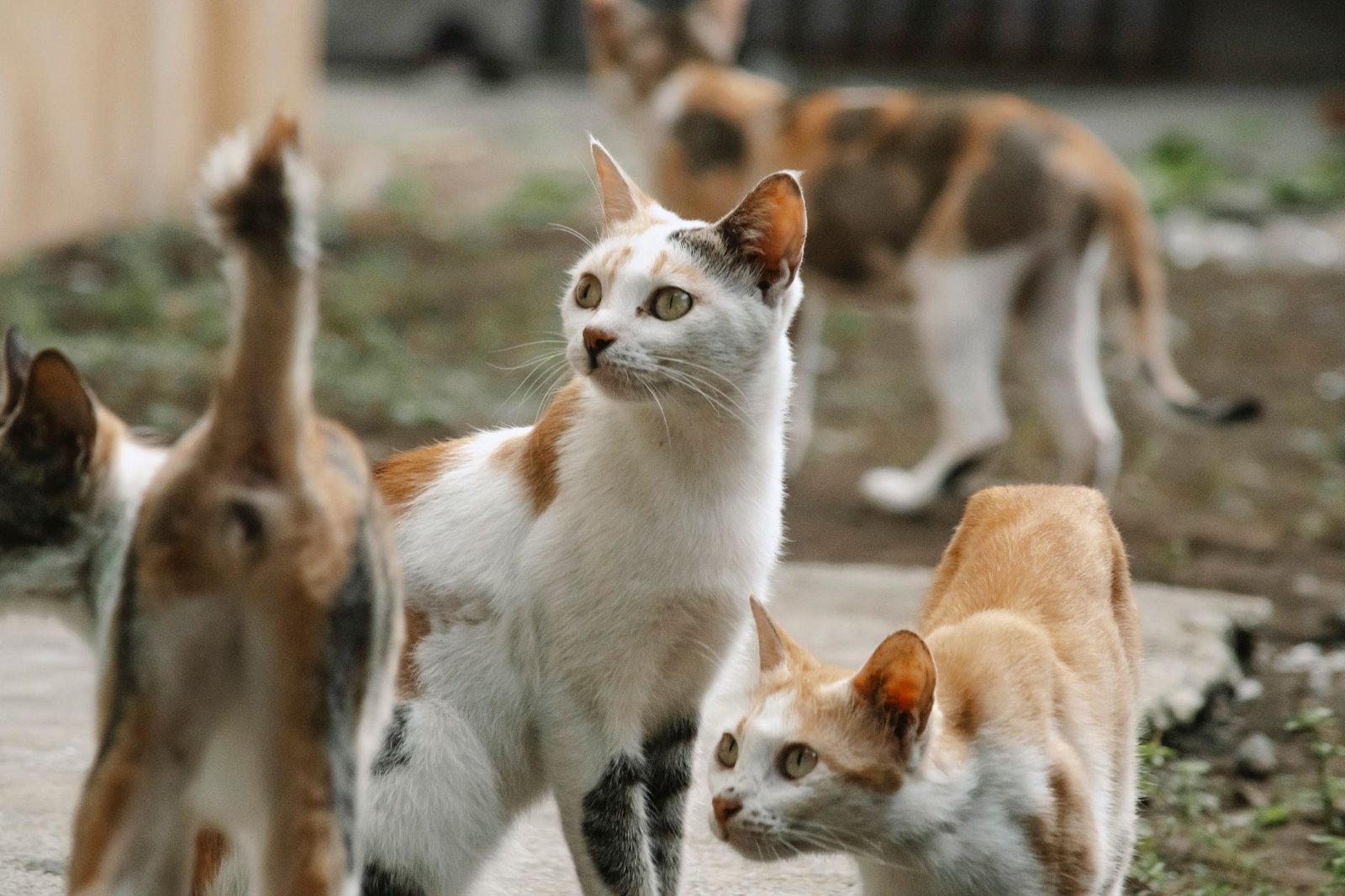
A cat who lives outdoors needs three things once the nights turn cold: a dry shelter small enough to hold their own body heat, water that is not frozen, and more food than they ate in August. Those three cover most of what goes wrong. The rest is knowing which signs mean a phone call rather than a wait.
Outdoor cats are common in Ladner and Delta
Between the farm properties, the older residential streets and the acreages out towards the water, Delta is full of cats who spend most or all of their lives outside. Some are family cats with a cat door. Some are working barn cats who belong to a property. Some belong to nobody in particular and are fed by three different households who each think they are the only one.
All three groups hit the same wall in late October. Daylight shortens, the rain sets in, the ground stays wet, and the shelter that was perfectly adequate in September stops being adequate. Cats are good at finding somewhere warm. The trouble is that the warm places they find are often engine bays, equipment sheds, machinery, and the gap under a parked trailer.
Shelter: smaller is warmer
The most common mistake is a shelter that is too big. A cat heats a shelter with their own body, so a large box full of air stays cold. Aim for something a cat can turn around in and no more.
- Raise it off the ground. On a pallet, a couple of bricks, anything. Cold and damp come up from the ground before they come in through the walls.
- Use straw, not hay, and not blankets. Straw is hollow, so it traps air and sheds moisture. Hay packs down, holds damp and goes mouldy. Blankets and towels absorb water and then freeze, and outdoors they will get damp, which makes them worse than nothing.
- Two openings, or one small one with a baffle. A cat needs a way out if something comes in, and a doorway just big enough to pass through keeps the wind out.
- Face the opening away from the prevailing wind and away from the open side of a yard.
- Put it where the cat already goes. A perfect shelter in the wrong corner of the property stays empty all winter.
If you have an outbuilding, a door propped open by five or six inches with a straw-filled box inside beats any purpose-built shelter in the open. If several cats use the property, give each one somewhere to go. Cats share space grudgingly, and the one at the bottom of the order is the one who ends up sleeping in the rain.
The car hood, and the other warm trap
Every autumn there are cats who climb into a wheel well or onto a warm engine overnight and are still there in the morning. The injuries that follow are severe, and most of them are avoidable. Bang on the hood, give it a moment, then look in the wheel wells and under the vehicle before you drive off.
Before you start a vehicle that has been parked outside overnight, bang on the hood and give it a moment. If you park in a garage or a shop, look before you shut the door, and check again before you open it. On a farm property, the same applies to anything with a warm block: tractors, generators, pumps and the inside of a round hay bale wrap.
The other trap is chemicals. Garages and workshops fill up with coolant, windshield fluid and bar oil at this time of year, and a cat who walks through a spill then grooms their paws has swallowed it. Coolant is the serious one, and a cat does not need much of it. Keep the containers sealed and up off the floor, and wipe up spills on concrete rather than leaving them to dry. If you think a cat has walked through coolant or licked any, phone an open veterinary hospital straight away. That one is measured in hours, not overnight, and it is not something to wait for signs on.
Food and water in the cold
A cat living outside in a Delta November is burning noticeably more energy than the same cat in July, just to stay warm. If you feed outdoor cats, increase the amount through the cold months and go back down in the spring. A cat who is losing weight across the autumn is a cat who is not getting enough, or is unwell, and from the outside those two look identical.
Water is the part that gets forgotten. A cat can go a long time on not very much food and a short time on not very much water, and a frozen bowl is an empty bowl. Use a deep, dark-coloured bowl rather than a wide shallow one, put it in the sun if there is any, and refill it morning and evening rather than topping it up. Do not use a metal bowl in freezing weather.
Wet food freezes quickly, so if you feed it, put it out at a set time and take the dish back in. Dry food keeps better outside but attracts rodents, and rodents attract the kind of bait that poisons cats. If you have put rodent bait anywhere on the property, assume an outdoor cat can reach it. If bait is already down and the cat could have got to it, or you find a dead rodent on the property, phone us the same day even if the cat looks completely well, and bring the product packaging. Signs from bait can take several days to appear.
Our notes on joint stiffness and cold weather are worth a read if your outdoor cat is getting on in years, because the stiff older cat who cannot jump to their usual sleeping spot will pick a worse one instead.
The health checks that actually matter before winter
A cat who lives outside has a different risk profile from one who does not, and autumn is the sensible moment to get ahead of it. The things worth sorting now, before the weather closes in:
- Parasite cover. Fleas do not stop in the cold, they move indoors and into sheltered spaces, and outdoor cats hunt, which brings its own parasites.
- Vaccination status. Outdoor cats meet other cats, and the respiratory infections that circulate in cat colonies spread fastest when animals are crowded into the few dry spots on a property.
- Identification. A microchip is the only identification that stays on a cat who slips a collar in a hedge. If the chip is already in, confirm the registry has your current phone number.
- Weight and body condition. Feel the ribs and the spine rather than looking at the fur, because a thick autumn coat hides a great deal.
- Teeth and gums. A sore mouth in October becomes a cat who stops eating in January, exactly when they need the calories most.
- Spay and neuter status. Unneutered cats roam further, fight more and are over-represented among the cats hit on the road. An unspayed female in a mild Delta winter can still produce a late litter.
Our wellness programs are built around exactly this kind of once-a-year catch-up, and our diagnostics can sort out the cat who is thin and drinking more from the cat who is thin and simply underfed, which is not a distinction you can make by watching.
Barn cats and community cats specifically
Working cats are often in very good condition, and often the hardest to get into a carrier. If the cat is handleable, autumn is the right time to use that, because a cat you can get into a carrier in October is a cat you can get help for in February. If the cat is not handleable, a humane trap and a plan beats chasing.
For community cats that several neighbours feed, the useful step is a conversation. Agree who feeds, when, and how much, so the cat is neither going hungry nor being fed four times a day by four different people. Agree who is responsible for getting the cat seen if something looks wrong, because the cat everybody feeds is usually the cat nobody takes in.
Where a group of cats is breeding on a property, neutering is the only thing that changes the trajectory. One unspayed female can turn into a colony within a couple of breeding seasons, and a colony in a Delta winter means kittens born in the cold.
Signs worth a phone call
Outdoor cats hide illness well, and they are not under your eye all day, so you are working from a smaller set of clues. Things that justify getting the cat in:
- A cat who stops showing up at feeding time, or shows up and does not eat.
- Obvious weight loss, or a coat that has gone rough and unkempt.
- Limping, a held-up paw, or reluctance to jump up where they always jump up.
- A swelling anywhere, especially on the face, neck, shoulder or base of the tail. Bite wounds from fights seal over and turn into abscesses underneath.
- Runny eyes or nose, sneezing, or noisy breathing.
- Drooling, pawing at the mouth, or dropping food.
- Sitting hunched in the rain rather than going to shelter. A cat who stops seeking warmth is a cat in trouble.
Signs that mean now rather than later: collapse, obvious injury, bleeding, laboured or open-mouthed breathing, a cat who is cold to the touch and unresponsive, or a tom straining and producing nothing. Phone us and bring the cat in through our urgent care. Our doors are open 8:00 AM to 8:00 PM on weekdays and 9:00 AM to 5:00 PM on Saturday and Sunday. Anything that happens outside that, overnight or in the hours before we unlock, should not wait on us: take the cat to whichever emergency hospital is open and call ahead from the car.
Warm a chilled cat gradually on the way, wrapped in something dry, with the car heater on low rather than blasting. Do not use a hot water bottle directly against the skin and do not rub frozen ears or paws, because that does more damage.
Frequently asked questions
How cold is too cold for a cat to be outside in Delta?
There is no single number, because it depends on the cat’s age, coat, body condition and whether they are wet. Our rule of thumb is that near-freezing temperatures combined with rain or wind are more dangerous than a dry frost, and that kittens, thin cats, short-coated cats and older cats need to be indoors well before a healthy adult would.
Should I bring my outdoor cat inside for the winter?
If the cat will accept it, yes, and it is the single most protective thing you can do. Do it gradually: start with the garage or a mud room, provide a litter box, and expect a few weeks of complaint. A cat who has never been indoors may genuinely do better with an excellent shelter than with a sudden move inside.
Is a heated bed or pad safe in a cat shelter?
Yes, but only the right kind. Use a pad made for outdoor animal use, rated for damp conditions and thermostatically controlled, on an outdoor-rated cord plugged into a GFCI-protected outlet. Check the cord for chew damage before the season and again during it, because rodents go for cords. Put a thin cover over the pad rather than piling loose straw on top of it, and keep the shelter roomy enough that the cat can lie completely off the heat. Never run an indoor heating pad or an indoor extension cord out to a straw-filled box. And a cat who is too cold or too weak to move off the heat needs to be seen, not warmed harder. Straw and good construction do most of the work without any electricity at all.
My barn cat looks thin but eats constantly. Is that just the cold?
Possibly, but a cat who eats well and still loses weight is a pattern worth acting on quickly, because several of the common causes in older cats are manageable when caught early. Bring them in rather than adding more food and hoping.
One of the cats I feed has a lump on its cheek. Does it need to be seen?
Yes, and soon. A firm, warm swelling on the face or neck of an outdoor cat is usually an infected bite from a fight, and it will not resolve on its own. These are straightforward to deal with early and much harder once the skin breaks down.
Can I feed outdoor cats without attracting rats and raccoons?
Mostly, with discipline. Feed at a set time, in daylight, and take the dish in afterwards. Never leave a pile of dry food out overnight. If you are already dealing with rodents, speak to us before putting bait down, because bait placed where a cat hunts is a well recognized autumn problem.
Do outdoor cats need the same yearly visit as indoor cats?
They need it more. An outdoor cat meets more parasites, more other cats and more hazards, and shows fewer early signs because nobody is watching them indoors all day. Once-yearly is a minimum, and nutrition counselling for a cat whose energy needs swing with the seasons is a useful part of it.
Speak to the team at 48th Avenue Animal Hospital
If you look after an outdoor, barn or community cat in Ladner or Delta and something about them has changed this autumn, phone us and describe it. We can also talk through getting a cat in who does not like being handled. We open at 8:00 AM Monday to Friday and 9:00 AM on Saturday and Sunday; if it is outside our hours and the cat cannot wait, go straight to the nearest open emergency hospital.
Published by the team at 48th Avenue Animal Hospital.
This article is for general educational purposes only and is not a substitute for an in-person veterinary examination or advice about your individual pet. If you have an urgent concern about your pet, contact 48th Avenue Animal Hospital or your nearest emergency veterinary hospital right away.
48th Avenue Animal Hospital
5020 48 Ave, Delta, BC V4K 3V3
Phone: (604) 946-7779
Hours: Monday to Friday 8:00 AM to 8:00 PM; Saturday and Sunday 9:00 AM to 5:00 PM